- Home ›
- Activities ›
- Meteors & Star Parties
FTC Disclosure: If you make a purchase via a link on this site, I may receive a small commission on the transaction - at no added cost to you. Thank you!
The Cape Cod Night Sky:
Stargazing is Just the Beginning!
Meteor showers, super moons, eclipses, and views of the International Space Station, too. Here's a look at all the celestial events we'll see across Cape Cod's night sky this year.
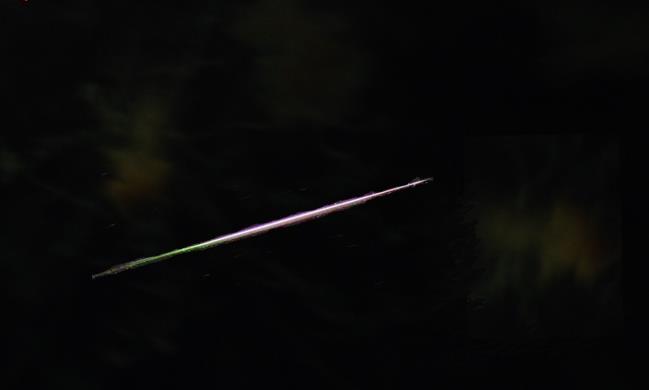
*FYI: These celestial events will be visible nearly everywhere in the northern hemisphere. So you should be able to see them anywhere in the USA. :-)
Read on to find out about:
- Meteor Showers - peak dates and times to look for shooting stars, plus my tips for best places to watch here on Cape Cod, and what to bring with you.
- Supermoons & Eclipses - when they'll happen this year
- International Space Station - how to see the ISS with the naked eye.
- "Star Parties" - free events where you can meet up with amateur astronomers and see the heavens through their telescopes.
Meteor Showers
January 2-3, 2026 - The Quadrantids
Yes, this is a chilly one! So bundle up and grab a thermos of hot cocoa to take with you if you're going out on meteor watch.
There'll be a full moon this night, so it'll be challenging to see all but the biggest, brightest fireballs streaking across the sky.
- Best Viewing Time: Late night on January 2nd to just before dawn on January 3rd.
- Average Rate in Dark Skies: 40+ meteors per hour
April 21-22, 2026 - The Lyrids
The Lyrids are somewhat unpredictable. Normally, the Lyrid meteor showers only produce a few visible meteors per hour. But on a good year, the rate might rise to 100+ per hour.
For this year's sky show, the quarter moon will set early enough that we might see some Lyrids.
- Best Viewing Time: Late evening on April 21st to dawn on April 22nd
- Average Rate in Dark Skies: 10-20 per hour
August 12-13, 2026 - The Perseids
This is one of the best known, most-watched meteor showers of all ... and my personal favorite for a couple reasons.
First, the Perseids reliably produce some awesome meteor sightings year after year.
Second, and maybe most importantly - it's warm here in August. It's a wonderful time to be outdoors gazing up at the stars!
On peak night for the Perseids in 2026, we'll have no interference from the moon. If the skies are clear, no doubt we'll have plenty of shooting stars to see!
- Best Viewing Time: From around 11 p.m. on Aug. 12th into the pre-dawn hours of Aug. 13th
- Average Rate in Dark Skies: 80+ per hour
October 7, 2026 - The Draconids
The Draconids (a/k/a "Giacobinids") meteor shower is usually a pretty sparse event with only a few sightings each hour. But on rare occasion, it produces a magnificent display.
The Draconids are mostly seen in the evening hours shortly after dark, so there's no need to get up in the middle of the night to see them. A waning crescent moon shouldn't pose much problem for seeing a few Draconids shooting across the sky.
- Best Viewing Times: Nightfall into early evening on October 7th.
- Average Rate in Dark Skies: Usually just a few per hour, but on an exceptional year it could be hundreds per hour.
October 21-22, 2026 - The Orionids
With only a few sightings an hour, this is one of the annual sky events that I don't bother setting my alarm clock for.
This year we'll have no interference from the moon on peak night for the Orionids, so the sky will be plenty dark for meteor-spotting. If you're going to be awake in the wee hours of the morning, you might be lucky enough to see an Orionid fireball or two.
- Best Viewing Time: Late night on October 21st to just before dawn on October 22nd
- Average Rate in Dark Skies: 10-20 per hour
November 17-18, 2026 - The Leonids
In 2001 the Leonids produced the most breathtaking display I've ever seen!
At one point during the night, almost everyone in our neighborhood was on the beach, braving unseasonably cold conditions, watching hundreds of shooting stars flashing through the sky.
That's a rare occurrence, though. The Leonids usually put on a much more subdued performance.
This year, the moon will be about 45% full, but it will set a little after midnight. So we should have a good chance of seeing a few meteors in the hours between midnight and dawn if the skies are clear.
- Best Viewing Times: Pre-dawn on November 18th
- Average Rate in Dark Skies: 10-20 per hour
December 13-14, 2026 - The Geminids
This is usually one of the best meteor showers of the year with the brightest Geminids sometimes showing colors of blue, yellow or green.
This year the waning crescent moon sets in the early evening, so it won't put a damper on our viewing. So let's hope the night of December 13th into the 14th brings us clear skies and lots of Geminid meteors streaking above us!
- Best Viewing Time: Late night on December 13th to pre-dawn on Dec. 14th
- Average Rate in Dark Skies: 75-100+ per hour
Where to Watch Meteor Showers on Cape Cod
The best viewing spot for meteor showers is as far away from bright lights as you can get.
On Cape Cod, that means almost anywhere is good ... except the more commercial areas of Falmouth, Mashpee, Hyannis, Orleans and Provincetown
My recommendation? Scout out a few potential viewing locations the night before the shower so you'll know where it's darkest.
Meteor Watching at the Beach: What To Bring
Here's my short list of "must-have" items:
- Warm clothes. It gets chilly at night when you're near the water, even in the summer months.
- A beach blanket, inflatable raft or air mattress. For the most comfortable viewing, you'll want to lie flat on your back -- or as stretched out as possible. (Ignore this advice at your own risk. Many a stiff neck has come from watching the sky while standing or sitting upright, head tilted back. I've learned this lesson the hard way.)
- A flashlight. If you've picked the right place, you'll be totally in the dark until your eyes adjust. Bring a flashlight - with fully charged batteries - so you can see where you're going.
- Bug repellant. In late spring, summer and early fall, the evening hours can be a little "buggy". So don't forget your bug repellant. (Here's what I use.) Better to have it and not need it, than to need it and not have it.
- Snacks and drinks. No, not alcoholic beverages. Those aren't allowed on public beaches ... and it's against the law to drink and drive, anyway. But do bring some snacks and other beverages. And please, dispose of your trash properly. Help us keep our Cape Cod beaches beautiful!
Meteor Shower Lodging
Want to walk out your door and see the stars shooting over the ocean? Consider staying somewhere on the waterfront:
Lunar Eclipses in 2026
Want to see an eclipse of the moon (a/k/a "lunar eclipse)?
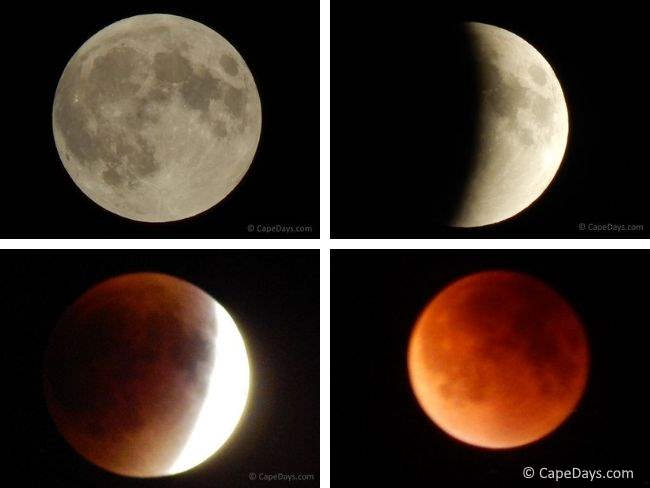
There will be two this year:
- Total eclipse - this event will begin in the wee hours of March 3rd (3:44 a.m. EST) and will be visible until the moon sets during the time of totality (6:18 a.m. EST).
- Partial eclipse - the moon will be up for the entire duration of this eclipse which begins mid-evening (9:22 p.m. EST) on August 27th and ends in the pre-dawn hours (3:30 a.m. EST) on August 28th.
"Super Moons" in 2026
When the moon is full and at perigee (its closest point to the earth), that's a full-moon supermoon.
What's so "super" about it? The moon looks larger and shines much more brightly than a normal full moon.
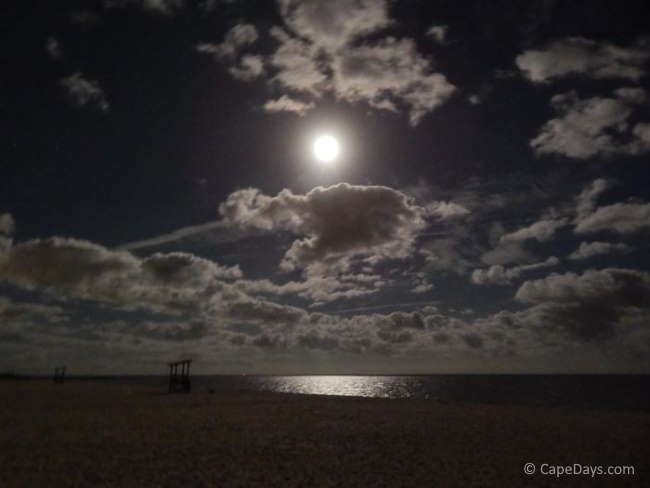 Super Moon Over Seagull Beach a Few Hours After Sunset
(Moonlight so bright I could see colors on the beach!)
And when it's near the horizon, the moon appears gigantic!
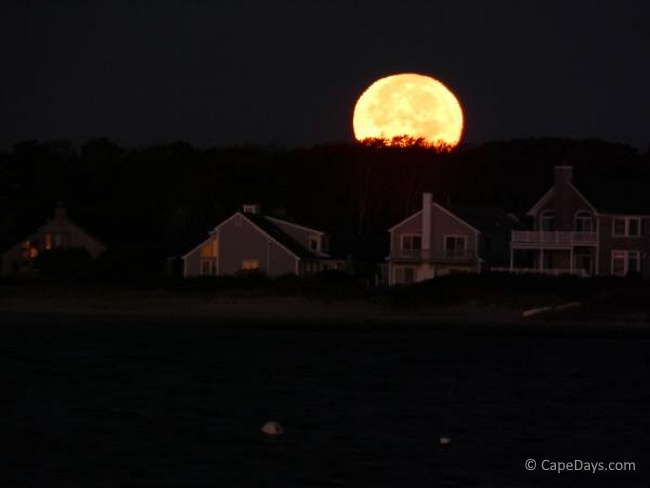 Super Moon Setting On Nantucket Sound Just Before Dawn
(All I can say is, "Breathtaking!")
There will be three full-moon supermoons in 2026:
- January 3rd
- November 24th
- December 23rd
Did You Know?
No matter where you are on Earth, you can watch the International Space Station (ISS) pass overhead. Telescope not required!
"Star Parties" on Cape Cod
Throughout the year, local astronomy groups host "Star Parties" in several locations on Cape Cod.
These friendly, knowledgeable folks set up their telescopes and invite visitors to gaze through the lens.
They're happy to share their wealth of knowledge about the stars, the planets, and pretty much anything else you'd like to know about the night sky.
The Star Parties are open to the public and free to attend.
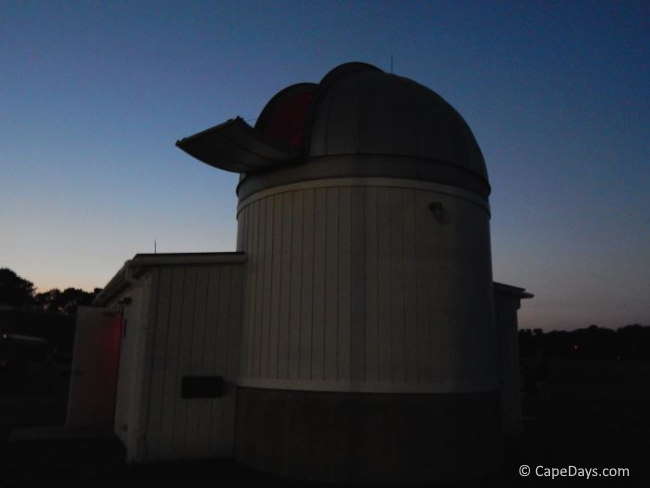 Werner Schmidt Observatory
Cape Cod Astronomical Society Star Parties
Cape Cod Astronomical Society hosts their events at Dennis-Yarmouth High School in South Yarmouth, home of the Werner Schmidt Observatory.
For details and schedule, visit Cape Cod Astronomical Society's website.
Harwich Observatory Star Parties
Monomoy Regional School District's star parties are held at Harwich Elementary School's observatory.
These gatherings are normally put on hold during the winter months, resuming sometime in March.
Check the Harwich Observatory website for details and schedule.
Osterville Village Library Star Parties
Osterville Village Library also holds Star Parties every now and then.
OVL's astronomy program's experienced guides host these early-evening meet-ups at Dowses Beach on the shores of Nantucket Sound.
See OVL's website to find out about upcoming star parties.
- Home ›
- Activities ›
- Meteors & Star Parties
Search This Site
FTC Disclosure: If you make a purchase via a link on this site, I may receive a small commission on the transaction - at no added cost to you. Thank you!
Recent Articles


-
Climbing Cape Cod Lighthouses: Getting Past the Nerves
Want to climb a Cape Cod lighthouse, but nervous about heights or tight spaces? Here are some real-life insights and a few practical tips from a fellow nervous climber. -
Cape Cod Events Calendar: Fun Things to See & Do in May 2026
What's happening around Cape Cod in May 2026? On this month's events calendar you'll find lots of fairs, festivals, and special events, along with ... -
Visiting Hyannis MA: All About Cape Cod's Largest Village
Wondering if Hyannis is the right Cape Cod vacation spot for you? Here's what visitors should know about Hyannis MA and its beaches, attractions, lodging, ...

Cape Days: Your Go To Cape Cod Guide SM
Copyright 2008-2026 - Doné ("Dee") Young
CapeDays.com
All rights reserved.
* As an Amazon Affiliate I earn from qualifying purchases *
Privacy Policy | Terms of Use | FTC Disclosure | About | Contact | Site Map | Legal
Member of Yarmouth MA Chamber of Commerce